Page 5 of 11
SU7.1-2 | Surgical Audit and Clinical Research — SDL Guide (Part 2)
Conducting Research Responsibly: Governance, Consent and Basic Statistics
Designing a sound study is only part of the picture; clinical research must also be conducted responsibly and interpreted correctly. The steps of a research project run from formulating a focused research question and hypothesis, through a literature review, choice of an appropriate study design, calculation of an adequate sample size and a written protocol, to data collection, analysis and reporting. Two governance requirements are non-negotiable for any study involving human participants and mark the sharpest contrast with audit. First, the project must receive prior approval from an Institutional Ethics Committee (IEC) / Institutional Review Board (IRB), which weighs the scientific merit and the risk-benefit balance and protects participants — drawing directly on the ethical principles of the preceding SDL. Second, each participant must give informed consent to take part, having understood the study's purpose, procedures, risks and their freedom to withdraw; this is autonomy applied to research. Audit, by contrast, examines existing practice and ordinarily needs neither. Finally, the surgeon must interpret the basic statistics every paper reports. The p-value is the probability of obtaining the observed result, or one more extreme, if the null hypothesis (no real effect) were true; by convention a value below 0.05 is taken as statistically significant, though significance is not the same as clinical importance. The confidence interval (CI) — conventionally 95% — gives the plausible range for the true effect and conveys precision: a wide interval signals uncertainty, and if a 95% CI for a risk ratio or odds ratio crosses 1 (no effect), the result is not statistically significant. Reading these two numbers together tells you both whether an effect is likely real and how precisely it has been measured.
Provided image
- Research steps: question/hypothesis → literature review → design → sample size & protocol → data collection → analysis → reporting.
- Governance: ethics-committee (IEC/IRB) approval and participant informed consent are mandatory for human research; audit ordinarily needs neither.
- p-value: probability of the result (or more extreme) under the null hypothesis; <0.05 conventionally 'significant' — but significant ≠ clinically important.
- Confidence interval (95%): plausible range for the true effect; a CI for a ratio that crosses 1 means the result is not statistically significant.
Check Your Understanding
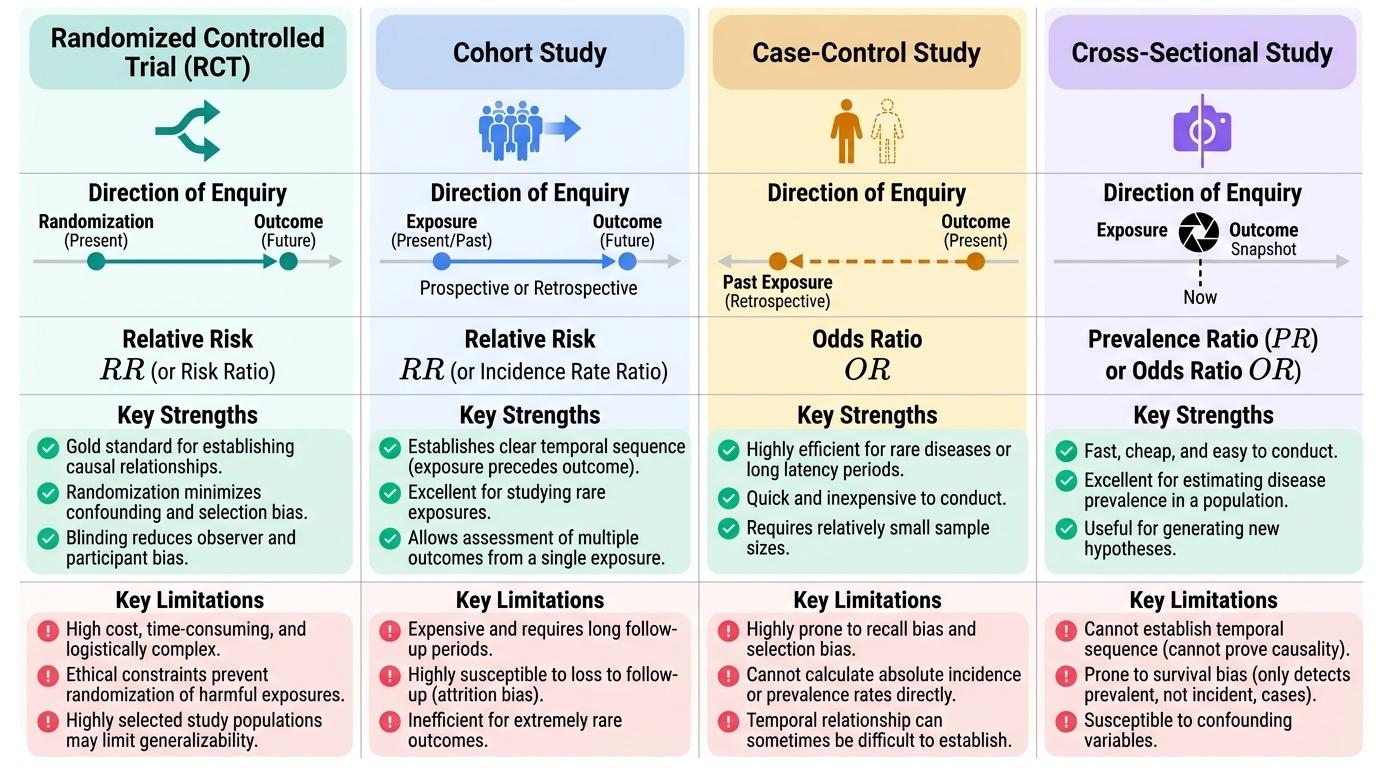
Before moving on, consolidate the module by reasoning rather than recalling. Return to the two registrars from the opening case and be able to justify, in one sentence each, why the first is doing audit and the second research — the first compares practice against an existing standard and closes the loop with re-audit, needing no ethics approval; the second tests a hypothesis about a new dressing to generate new knowledge, and therefore needs ethics-committee approval, participant consent, and statistical analysis. Test yourself on three linked skills. First, given a one-line description of a project, can you classify it correctly as audit or research, and state the single feature that decides it (existing standard vs hypothesis-driven new knowledge)? Second, can you put the five steps of the audit cycle in order and explain why the re-audit step is the one that actually delivers improvement? Third, can you rank a set of studies on the hierarchy of evidence and say what each design can and cannot show — for instance, why a case-control study gives an odds ratio but cannot establish incidence, or why a result whose 95% confidence interval crosses 1 is not significant? Reasoning each scenario through these frameworks, rather than memorising lists, is what turns this material into usable judgement. The questions below check exactly these links.
CLINICAL PEARL
When you read a surgical paper or plan your own project, ask one question first: is this audit or research? If it compares practice against an existing standard, it is audit — close the loop with a re-audit, and you need no ethics approval. If it tests a hypothesis to create new knowledge, it is research — you need ethics-committee approval and participant consent before you start. Then, when you read the results, never stop at the p-value: a statistically significant result (p<0.05) may be clinically trivial, and the confidence interval tells you how precise — and how believable — the effect really is. A narrow CI well away from no-effect is far more persuasive than a 'significant' p-value attached to a hopelessly wide one.
SELF-CHECK
A trial reports that a new technique reduces complications with a risk ratio of 0.80 and a 95% confidence interval of 0.55 to 1.15. How should this result be interpreted?
A. A clearly significant reduction in complications
B. Not statistically significant, because the 95% confidence interval crosses 1 (no effect)
C. Proof that the technique causes harm
D. Invalid because risk ratios cannot have confidence intervals
Reveal Answer
Answer: B. Not statistically significant, because the 95% confidence interval crosses 1 (no effect)
Although the point estimate (RR 0.80) suggests a reduction, the 95% confidence interval runs from 0.55 to 1.15 and therefore includes 1, the value of no effect. When a confidence interval for a ratio crosses 1, the result is not statistically significant — the true effect could plausibly be a reduction, no change, or even a small increase.