Page 5 of 20
SU28.14 | Disorders of Small Intestine and Large Intestine — SDL Guide (Part 2)
Principles of Surgical and Medical Management
Management follows directly from the pattern and from whether the bowel's blood supply is threatened. Simple adhesive small-bowel obstruction is usually managed first conservatively — the classic 'drip and suck': nil by mouth, intravenous fluids to correct the dehydration and electrolyte loss, and a nasogastric tube to decompress the stomach — with surgery reserved for failure to settle or any sign of strangulation, which mandates immediate laparotomy. A strangulated hernia is repaired urgently. Sigmoid volvulus is often decompressed endoscopically (flatus tube) in the first instance, with sigmoid resection for recurrence or gangrene. Intussusception in a stable infant is reduced by air or contrast enema, with surgery if reduction fails or there is peritonitis. Inflammatory bowel disease is primarily medical — aminosalicylates, corticosteroids for flares, immunomodulators and biologics — with surgery for complications: in ulcerative colitis colectomy can be curative (the disease is confined to the colon), whereas in Crohn's surgery is bowel-conserving and reserved for complications (strictures causing obstruction, fistulae and abscesses) because the disease recurs after resection and can involve any segment. Colorectal carcinoma is treated by oncological resection following the artery and its draining nodes (right hemicolectomy, left hemicolectomy, sigmoid colectomy, anterior resection or abdominoperineal resection by site), with neoadjuvant chemoradiotherapy for many rectal cancers and adjuvant chemotherapy for node-positive disease; an obstructing tumour may need a defunctioning stoma or a stent first. Neonatal obstruction needs prompt resuscitation and tailored surgery, and short-gut syndrome is managed by nutritional support including parenteral nutrition and adaptation. The unifying principle throughout: resuscitate, decide simple versus strangulating, and operate without delay when the blood supply is at risk.
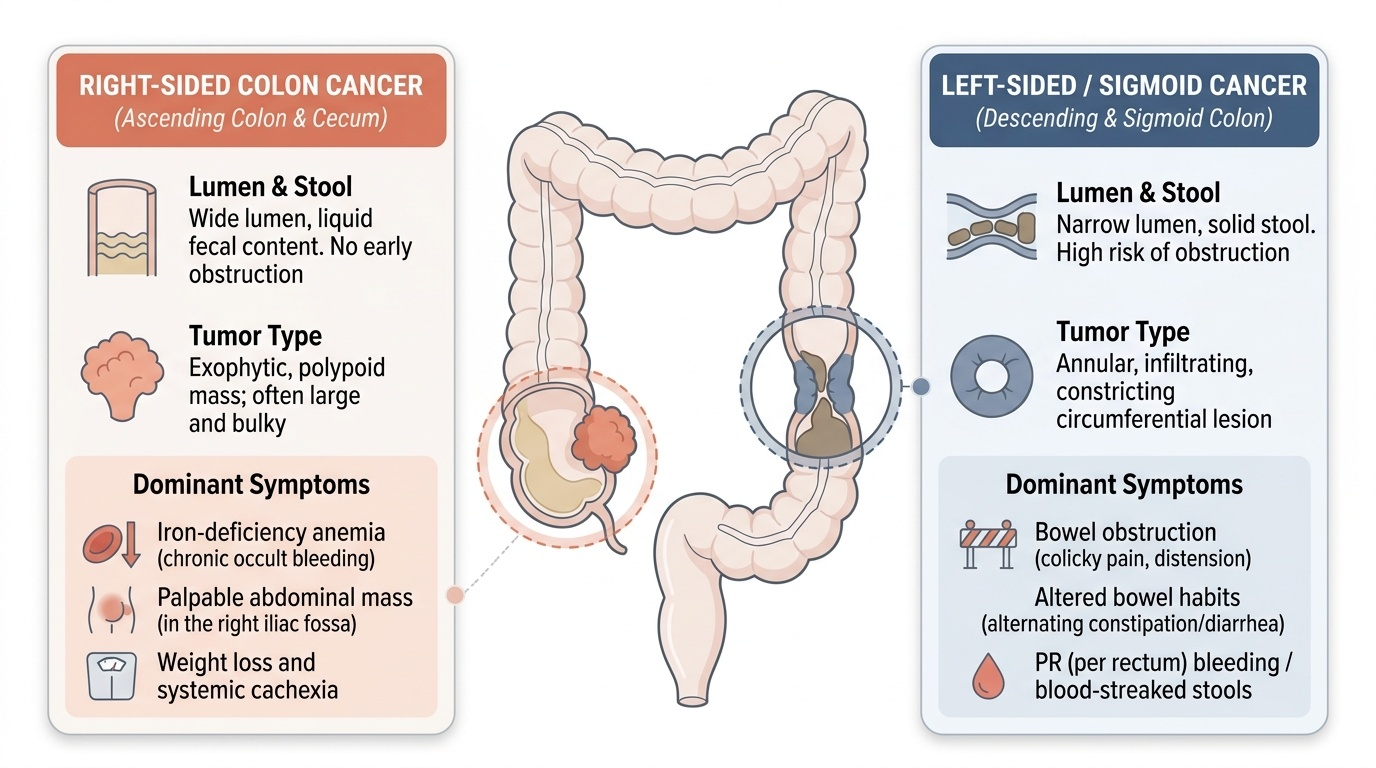
Provided image
| Feature | Right-sided colon cancer | Left-sided / sigmoid cancer |
|---|---|---|
| Lumen and stool | Wide lumen, liquid stool | Narrow lumen, solid stool |
| Dominant presentation | Iron-deficiency anaemia, mass, weight loss | Obstruction, altered bowel habit, PR bleeding |
| Typical timing | Presents late | Presents earlier with obstructive symptoms |
CLINICAL PEARL
Treat a large-bowel obstruction in an adult as colorectal cancer until proven otherwise, and never be reassured by a 'settling' obstruction with worsening signs. The danger sign across all obstruction is the shift from colicky to constant pain with tenderness, tachycardia and fever — that is strangulation, and it converts a conservative problem into an emergency laparotomy. In large-bowel obstruction with a competent ileocaecal valve, watch the caecum: a closed loop perforates the thin, wide caecum first (Laplace's law).
Check Your Understanding
Bring it together by reasoning through the three patients from the hook. The young adult with previous surgery, colicky central pain, bilious vomiting and modest distension has adhesive small-bowel obstruction — confirmed by central valvulae conniventes on the film, managed initially by drip-and-suck, with laparotomy only if it fails to settle or strangulates. The 68-year-old with months of altered bowel habit, dark blood in the stool, weight loss and now obstruction has a left-sided colorectal cancer until proven otherwise — worked up by colonoscopy and biopsy, staged by CT and (if rectal) MRI, and treated by oncological resection. The screaming infant with red-currant-jelly stool and a sausage-shaped mass has intussusception — confirmed by the target sign on ultrasound and reduced by air enema if stable. Now self-test the three competency strands. First, can you separate SBO from LBO clinically and on the film, and name the surgical emergencies (strangulation, volvulus, closed loop)? Second, can you choose the right investigation for obstruction versus suspected cancer versus IBD? Third, can you state the management principle for each — drip-and-suck versus urgent surgery, medical IBD with surgery for complications, oncological resection for cancer? The questions below check exactly these links.
SELF-CHECK
A 70-year-old has a large-bowel obstruction from a sigmoid carcinoma with a competent ileocaecal valve. Why is urgent decompression important, and which part of the bowel is most at risk of perforation?
A. The sigmoid; it is closest to the tumour
B. The caecum; a closed loop raises pressure and the thin, wide caecum perforates first (Laplace's law)
C. The rectum; it has the poorest blood supply
D. The duodenum; it bears the highest intraluminal pressure
Reveal Answer
Answer: B. The caecum; a closed loop raises pressure and the thin, wide caecum perforates first (Laplace's law)
A competent ileocaecal valve turns the obstruction into a closed loop: gas and fluid cannot vent backward, so pressure rises. By Laplace's law (wall tension rises with radius), the thin-walled, widest part — the caecum — is at greatest risk of perforation, making urgent decompression important.